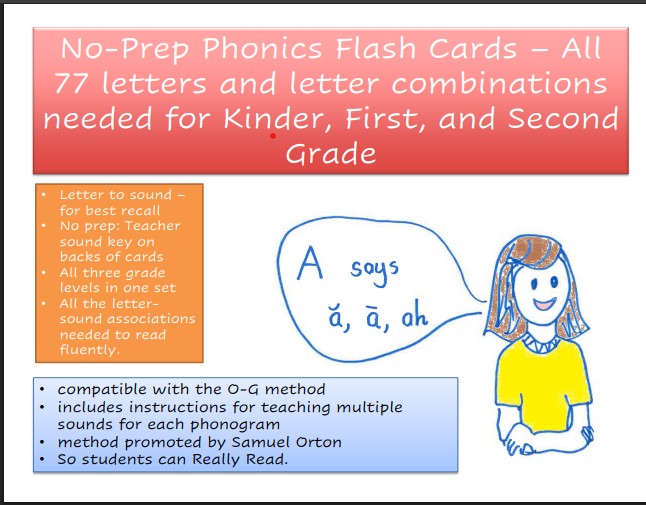
- 77 cards plus instructions.
- Printable PDF — for best results, use cardstock to make your own Science of Reading phonics cards.
- Revised for easier use after three homeschooled students and 15 years in the classroom
- Addresses dyslexia and other phonics and decoding- based reading difficulties.
- Teacher sound key in on back of cards — really, no prep!
- All the phonics your students need to read fluently in any grade.
- Cards are sequenced according to Common Core phonics sequence for grades Pre-K to 2. For home study, students can start at their current level and go forward.
- 4 by 5 1/2 inch size is appropriate for whole group, small group, or single student.
If your student didn’t get phonics when it was taught the first time, or you want to start your whole class or a single child on a sound phonetic foundation for reading, Science of Reading Phonics Cards is for you. Using these cards, you will be able to teach all the sounds, with the right number of repetitions, until your child can read. When done correctly, I warrant this the fastest and most effective phonics teaching method I know. As a former home schooling mom, I used these cards to teach my son to read after the public school could not, and his two brothers as well.
The current term, Science of Reading, refers to reading instruction in the tradition of Romalda Bishop Spauling and Orton-Gillingham, among others, who were the original opponents of Whole Language/Look Say reading instruction in the 1930’s and 40’s. This product is an authentic exercise in phonetic teaching, and its design is modified from Orton and Gillingham’s materials.
This is a flash card method but it is different for several reasons. Sounds are taught as they occur in words, and when a letter or group of letters has more than one sound, the student recites all the sounds (except in two cases, there are no more than three per phonogram, or letter group). These cards are ordered in grade level order, for use in a classroom; however, you will want to decide where to start with your student by checking their understanding. Only those letters and letter groups which make unique sounds are included; blends like /s/ + /p/ are skipped, as these can be sounded out. Digraphs which make a unique sound, like /th/, are taught. This reduces the number of phonograms to teach and makes the set more efficient.
Reviews
There are no reviews yet.