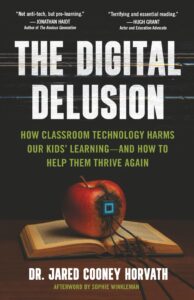
Two points stood out to me from this important book:
Digital learning is generally not an effective learning tool in K-12.
While data tells many stories, the correlation of flatlining, or even decreasing, reading scores over the past 13 years (along with a rise in tech use in schools) is worth investigating, and while correlation does not prove causation, the numbers from the National Assessment of Educational Progress (NAEP, or The Nation’s Report Card) reveal the following data: from 2012 to 2024, across all achievement percentiles, average scores fell or remained flat. The lowest-performing students are not making gains, nor are the highest-performing students. There were no increases in average achievement. This data is consistent for nine-year-olds as well as 13-year-old students. This is a national test given every few years to schools and students are chosen at random.
Some numbers on the history of the progress of computers in schools:
From 2012-2015, there were pilot programs with digital devices, mostly tablets and desktop computers, moved into schools.
From 2016-2019, many districts began issuing personal devices to each student, to use in class and at home to complete homework.
From 2020-2023, with the onset of the COVID-19 pandemic, districts rushed the purchase of devices for those who did not have access, generally in lower SES schools.
From 2024 to 2025, daily integration of digital devices, including cloud-based programs, often with district-mandated time that should be used for digital learning.
The Promise that Didn’t Come True
Computers and their programs were to be the great equalizer, offering access to all, regardless of family social status. This decision was justified by school boards and superintendents in part because data showed that lower-income students were not performing well in traditional classrooms. (Higher-income schools already had one-to-one devices in place.)
Reversing the “achievement gap” has been one of the great struggles of public education in this country over the past 50 years, but correlation of family income and low scores does not prove that low income causes learning difficulties. What was causing the difficulty? Could it be bridged by technology?
In a word, no. At this time, there is NO data to support that the introduction of computers to the classroom has helped low income, or any students perform at higher levels.
Horvath’s data suggests quite the opposite: that introduction of computers drives reading and math scores down.
One more fact: At the 12th-grade level, just 35% of students score at or above proficient. That means that 65% are not.
What we don’t see is a correlation with the increased amount of time on computers and significant, or any, growth. Something else we don’t see? Schoolbooks. All the lessons are cloud-based.
Horvath argues that:
Parents can and should disagree with schools that encourage, or require, digital learning at home.
Parents are overwhelmed with the demands of combining tech and family time. Many parents have rules similar to the following: no electronics during the school week, and no tech at all after dinner on weekends.
Perhaps they’ve experienced the moodiness that sets in when children turn off technology and return to the real world of home and play. Perhaps they’ve learned from experience that their children have trouble sleeping if the blue lights of screens are used too late. Sleep-deprived children rarely wake up with a sunny disposition, nor do they get the needed time for the brain to do its work: consolidating memories, processing the day’s learning, and regulating the body’s hormones.
Poor sleep results in anxiety and mood disorders, with the incidence rising alongside the amount of time spent on tech. This isn’t just an American issue; I’ve seen the same increases in poor behavior in classrooms in Italy and China, a disengagement with learning instead of what tech promised. Interestingly, many creators of digital programs do not allow their own children to use technology-except under strict supervision, encouraging family time, friends, sports, and outdoor time.
It will take courage for teachers and parents to push back on school demands of tech programs and platforms. It’s worth the work and the time to test another correlation: Does less time on tech and more time with traditional paper, pencil, and book learning increase achievement? The results will be eye-opening!
Some Background Information
Reddit Thread