How to set up small reading groups in an elementary classroom
Now that the school year is in full swing it is time to think about how to set up small reading groups.. This is a routine that many teachers never get to. That’s a shame because in my experience it is a super-effective support for striving readers. A key part of differentiated instruction. And it’s fun.
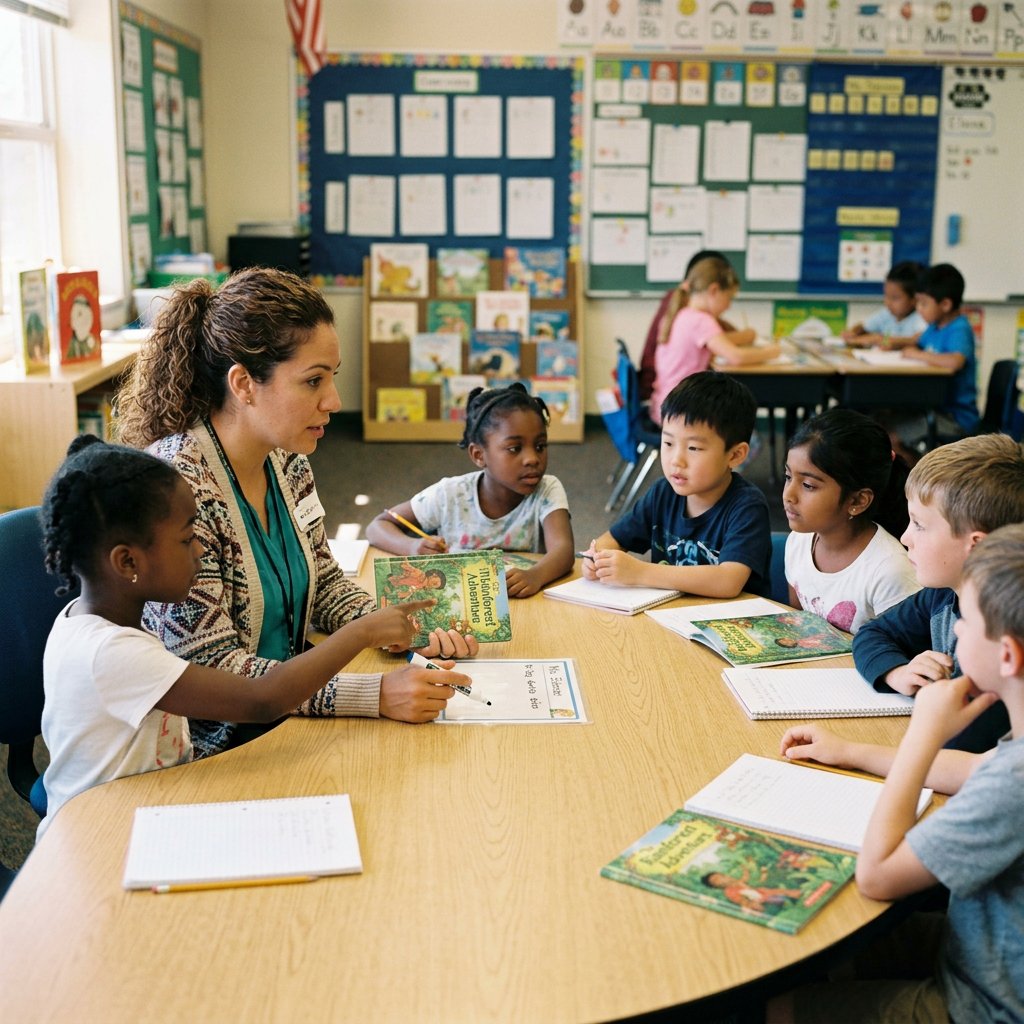
A small reading group is a set of students pre-selected for complimentary reading instructional needs. You call them to sit with you, perhaps at a kidney bean table, or perhaps on the floor, each with their own copy of the same book. The teacher and students read the book together, either chorally or by turns. This strategy for teaching reading is in my opinion the most effective thing you can do for struggling readers.
Ignore this classroom routine at your peril–or at least at the peril of your below-level students!
Setting up your groups:
In order to set up small reading groups you will need reading data. Most schools by this time of the year (September) have one or more reading inventories completed. These may include:
- DIBELS
- TPRI
- DRA
- Fountas and Pinnell
- I-Ready
- Expeditionary Learning Benchmark
- And others.
Some schools have two.
Rank the Students in Order of Need
There are a lot of numbers in some of these tests and it’s important that you ignore most of them. You are going to lose your mind if you start trying to decide whether you’re going to use nonsense word fluency or oral reading fluency as your primary or secondary ranking standard. Every reading inventory has a composite number or alphabet letter and that’s what we’re looking at. Don’t get bogged down in the subcategory data. It does not really play into reading groups.
Make a list of all the students from the lowest scores to the highest, using the composite score. This is a simple process. It may seem cut and dried; however you will have time to move students to a higher or lower group later if needed. What you need now more than anything else is to start.
So You Have Your List
Once you have this list in ascending order, you can divide the students into groups, starting at the top with the lowest scores. But before you decide how many groups to make, you need to think about how long the kids are in centers or independent work, and how many groups you can run during that time.
Generally, my schedule allows for two groups a day. In an ideal world, you would have three groups a day, but in my experience even for highly competent teachers this is not realistic. Two groups a day, 10 groups a week gives you 10 slots.
Most years, I divide the students into four groups. The highest need, lowest scoring groups should be smaller in general, no bigger than four. For on-level groups, it is possible to have seven or even more, but declining returns may occur. Another problem is that many reading programs only give you 6 leveled readers.
A sample instructional pattern might be:
| Student need | Group size | Frequency | Approximate time |
| More than one year behind | 2–3 | Daily | 15–20 minutes |
| About six months behind | 3–4 | 2–3 times weekly | 15–20 minutes |
| On grade level | 4–6 | 1–2 times weekly | 15–20 minutes |
| Above grade level | 4–7 | About once weekly | 15–20 minutes |
You need to try to read every day with the kids who are a year or more behind. Generally, I fill up my first morning group time with my lowest group. In my second group meeting slot I put three meetings for the next highest kids, one for the on-level and one for the high. That’s my 10 meetings.
| Monday | Tuesday | Wednesday | Thursday | Friday |
| Lowest Group | Lowest Group | Lowest Group | Lowest Group | Lowest Group |
| Second Lowest | On Level | Second Lowest | High Group | Second Lowest |
I’ll try to cover what to do if over half your class is “red” in a later post. It’s called Whole Group Intervention. But that is a plan for another day.
Do All the Kids Need a Reading Group?
Kids who are on level may progress adequately with no reading group. But for morale, you have to meet with them sometimes. I always try to meet with them once a week. Sometimes a volunteer wants to come to the classroom and this is a good group to give to them because these students are on track, they just need practice.
Select the Books
Each group will be reading books at an appropriate level. These books come with the curriculum, generally, and instructions in the curriculum tell you what book will be appropriate for which group. I made this conversion chart for my classroom library which is leveled to DRA.
DRA/Fountas and Pinnell /EL conversion chart.
In first grade, a rule of thumb is the students need to be able to read 9 out of 10 words correctly for the book to be on their level. In second grade the students need to be able to read 19 out of 20 or perhaps even, on the higher end, 49 out of 50 words correctly. If you give them the book and listen to them read, you are looking for a book where they are usually successful. The rest of the time, when they get stuck, you teach them the skills needed to read the miscued word.
There’s a sweet spot. Refer to the curriculum, pick out a book, get your group and start reading the book with them and you should have an idea at that point whether it’s the right fit or not. What we’re looking for is a book at what’s called “instructional level.”
I would not start thinking about specific skills. The list of skills that the students will develop as they read the correctly leveled book includes the following:
- Blending and decoding unfamiliar words
- Recognizing spelling patterns
- Reading high-frequency words
- Using punctuation and phrasing
- Building fluency
- Learning vocabulary
- Discussing meaning and comprehension
These skills come up spontaneously as students read the book and you can instruct them as needed.
During the first few group meetings, you can simply work on reading your book. Next week, I will post on how to structure your small reading group.
Happy small group time teachers!